
Does it matter where your colon cancer is located?
When most people think about colon cancer, they think about it as a single disease. But research tells a more nuanced story. Where a tumor originates in the colon — specifically, whether it's on the right side or the left side — can help shape how the cancer behaves, how it's detected, and, along with biomarker results, how treatment decisions are made. This concept, known as tumor sidedness, is becoming an increasingly important part of how doctors approach personalized colon cancer care.
If you or a loved one has been diagnosed with colon cancer, understanding sidedness is one more tool to help you ask the right questions and advocate for the most effective treatment plan.
A Quick Look at the Colon
To understand sidedness, it helps to know a little about how the colon is structured. The large intestine, a roughly five-foot-long muscular tube at the end of the digestive system, is divided into four main sections that work together to process waste and move it out of the body.
The organ starts at the ascending colon, which travels up the right side of the abdomen from a small pouch called the cecum. Next is the transverse colon, which crosses horizontally from right to left. Then comes the descending colon, moving down the left side, followed by the sigmoid colon, which connects to the rectum and anus.
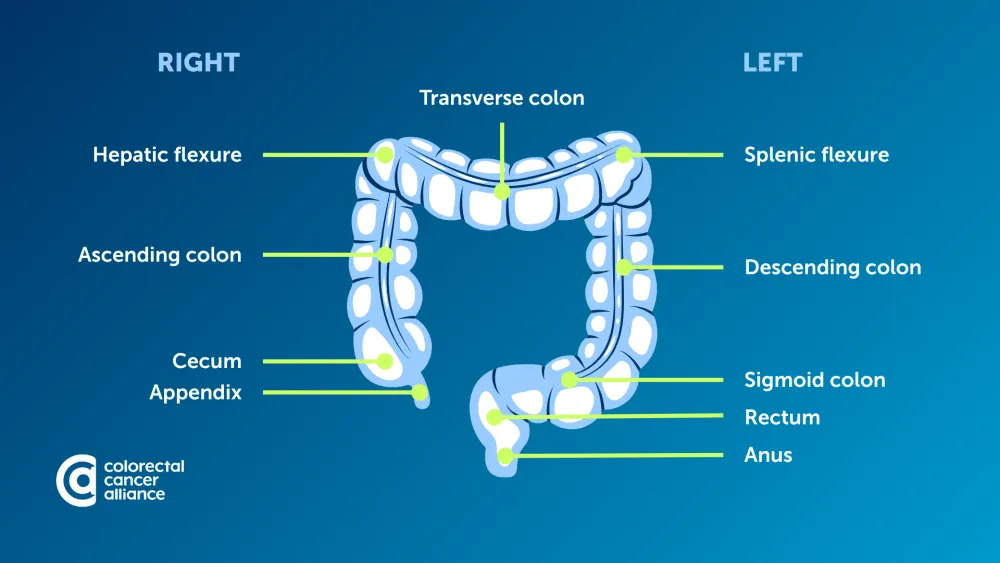
For the purposes of tumor sidedness, the right side of the colon includes the cecum, ascending colon, and hepatic flexure (the bend between the ascending and transverse colon). The left side includes the splenic flexure, descending colon, sigmoid colon, and rectum*.
Note: Some discussions of tumor sidedness include the rectum as part of the left side. However, rectal cancer is often treated differently from colon cancer, so your care team may consider it separately when planning treatment.
Why Location Matters: Right Side vs. Left Side
Scientists and oncologists have discovered that right-sided and left-sided colorectal cancers are biologically distinct — almost like two different diseases that happen to occur in the same general area of the body. These differences affect everything from who tends to get each type, to how the cancer grows, to which treatments are most effective.
Right-sided colorectal cancers are more commonly diagnosed in women, older adults, and African American patients, though these are general trends and can vary widely from person to person. They tend to grow from flat polyps that can be harder to detect during screening, which means they're often found at a later stage. Symptoms can be subtle, including things like fatigue, anemia, or hidden bleeding, rather than the more obvious bowel changes people often associate with colorectal cancer. On a molecular level, right-sided tumors often have certain genetic markers, including MSI-H/dMMR, BRAF V600E, and KRAS mutations. Tumors that are MSI-H/dMMR may respond particularly well to immunotherapy. However, they tend to respond less well to a class of targeted drugs called anti-EGFR therapies.
Left-sided colorectal cancers are more common overall and are diagnosed more often in men and younger patients. These tumors tend to cause more noticeable symptoms like constipation, narrow stools, or blockages, which can lead to earlier detection. They carry different molecular characteristics, including possible higher rates of HER2 amplification and sensitivity to EGFR-pathway treatments. In metastatic disease, patients with left-sided tumors often respond better to anti-EGFR targeted therapies like cetuximab or panitumumab when their biomarkers support it. Generally speaking, left-sided colorectal cancers carry a somewhat better overall prognosis, particularly in advanced disease.
It's important to note that tumor location is just one piece of the puzzle. Today, treatment decisions are driven primarily by biomarker testing — analysis of the tumor's molecular profile, including markers like RAS, BRAF, MSI/MMR, and HER2. Two patients with tumors on the same side of the colon may receive very different treatments based on those results. Sidedness and biomarkers work together to paint the most complete picture.
For a full breakdown of right-sided vs. left-sided characteristics, visit our dedicated webpage.
What This Means for You
Understanding tumor sidedness won't change your diagnosis, but it can change the conversation you have with your care team. Here are a few things worth bringing up at your next appointment:
- Ask about your tumor's location. Is your cancer right-sided or left-sided, and what does that mean for your specific treatment options and prognosis?
- Ask about biomarker testing. Have you been tested for RAS (KRAS/NRAS), BRAF, MSI/MMR, and HER2? Are there any additional tests that should be done?
- Ask how location and biomarkers work together. How do both factors influence the treatment plan being recommended for you?
- Ask about targeted therapy and immunotherapy. Based on your tumor's location and molecular profile, could either of these approaches be right for you?
- Ask about clinical trials. Are there any trials worth exploring now or in the future based on your tumor type?
- Ask about genetic risk. Should you or your family members consider genetic counseling or screening based on your tumor's features?
Colorectal cancer care has come a long way, and treatment is more personalized than ever. The more you understand about your specific cancer, including where it started, the better equipped you'll be to partner with your medical team in making informed decisions about your care.
Educational content developed with support from

Top resources

FDA approves Tecentriq for some people with stage III colon cancer
The FDA has approved Tecentriq (atezolizumab), given with chemotherapy after surgery, for people with stage III colon cancer whose tumors are mismatch repair deficient (dMMR). It’s the first immunotherapy approved for this use.
Alliance Breaks Down New ACS Screening Guidelines
The Colorectal Cancer Alliance is urging Americans to prioritize colorectal cancer screening, as the American Cancer Society (ACS) released updated guidelines today.

Bringing biomarker testing within reach: CLEAR for CRC to empower patients from day one
Biomarker testing can guide colorectal cancer treatment and improve outcomes. Learn how CLEAR for CRC is helping patients access this critical tool.