
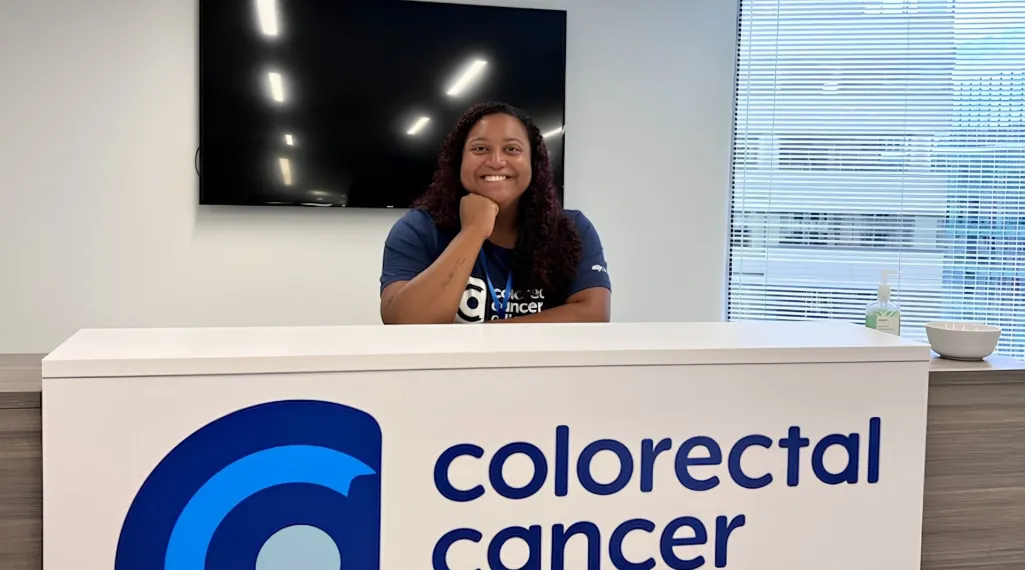
Why I answer the phone: A cancer care navigator's view
For Paige Edmonds, answering the Colorectal Cancer Alliance's helpline is personal.
Edmonds, a social worker with a master's degree, is one of several trained professionals on the Alliance's cancer care team, working alongside specialists in oncology social work, public health, and nursing. But her path to the helpline started long before she ever took a call.
In high school, a family member's cancer diagnosis showed her the kind of professional she wanted to become. Years later, while working as a hospital case manager, her father was diagnosed with stage IV (metastatic) colorectal cancer that had already spread to his liver.
As her family navigated financial barriers, second opinions, and the scramble to make sense of clinical trials, Edmonds learned firsthand how much expert support matters. Her father passed away two years later, just before the pandemic. Not long after, she found the Alliance.
"It felt like fate," she says.
Last year, the Alliance's cancer care team helped more than 10,000 people, guiding them through screening options, treatment paths, and ways to live well with the disease. Sometimes, Edmonds says, people just want to be heard.
"Cancer doesn't discriminate," she says. "Whether someone's young or old, whether they have everything or nothing at all, every person deserves a place to turn."
One saying guides her work: "To know even one life has breathed easier because you have lived, this is to have succeeded."
Anyone newly diagnosed, supporting a loved one, or simply looking for answers can call the Alliance's helpline at (877) 422-2030.
This story was adapted from an email first sent to Alliance subscribers. Subscribe here to get stories like this one directly in your inbox.
Top resources

FDA approves immunotherapy for MSI-H/dMMR stage II & III rectal cancer
The U.S. Food and Drug Administration approved dostarlimab (brand name Jemperli) as the first and only immunotherapy for adults with stage II or III rectal cancer that has a biomarker called MSI-H or dMMR.

FDA approves Tecentriq for some people with stage III colon cancer
The FDA has approved Tecentriq (atezolizumab), given with chemotherapy after surgery, for people with stage III colon cancer whose tumors are mismatch repair deficient (dMMR). It’s the first immunotherapy approved for this use.

A blood test that sees what scans can't
For many cancer patients, the end of active treatment brings a new kind of dread. Scans every few months and anxious waits for results. A blood test is changing that experience for a growing number of patients.