
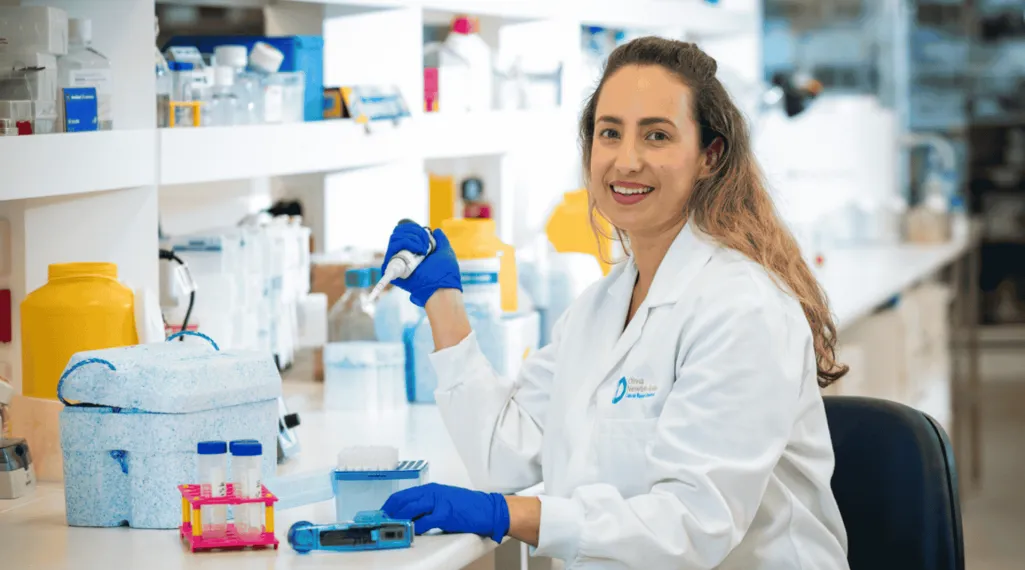
Where breakthroughs begin: Project Cure CRC spotlight on Dr. Lisa Mielke
Colorectal cancer research doesn’t often make headlines — especially when it’s early, exploratory science. But for Dr. Lisa Mielke, PhD, an associate professor at the Olivia Newton-John Cancer Research Institute in Australia, that’s precisely where the most promising breakthroughs begin.
Recently, Dr. Mielke and her team published research exploring a new way to understand, and potentially treat, colorectal cancer by looking beyond the tumor itself and focusing on the complex gut environment, including the immune system and even the nerves that run through it.
When you have an issue with something you’ve eaten, you know it based on how your stomach feels and reacts. Still, our gut is actually one of the body’s most powerful control centers, quietly influencing everything from immunity to disease risk.
Dr. Mielke’s research is a novel approach. One that might not always qualify for high-profile research funding, but thanks to support from the Colorectal Cancer Alliance’s Project Cure CRC, it’s moving forward and has the potential to transform how colorectal cancer is treated in the future.
Why the Gut Holds New Clues in Colorectal Cancer
Dr. Mielke’s scientific background is in immunology — the study of the immune system. What drew her to colorectal cancer wasn’t just the disease itself, but the environment where it develops.
“The gastrointestinal tract is such a unique place in the body,” she explained. “It’s full of microbes, metabolites, and immune cells, all interacting constantly. Yet for a long time, we haven’t fully explored how that environment influences cancer.”
Most colorectal cancer treatments today focus directly on tumor cells. While targeted therapies have improved outcomes, immune-based therapies, which have been revolutionary in some cancers, benefit only a small percentage of colorectal cancer patients.
Dr. Mielke’s research takes a broader view. Her team studies how immune cells, nerves, and signaling molecules within the gut may either fuel cancer growth or be harnessed to stop it.

What Makes This Research Different
One of the most distinctive aspects of Dr. Mielke’s work is its accessibility to patients, donors, and the scientific community.
Her published findings examine how neuropeptides, chemicals released by nerves in the gut, can enhance tumor growth. This insight opens the door to a surprising possibility: repurposing existing drugs — including medications already used to treat migraines — as part of future colorectal cancer treatment strategies.
“This is about looking at the tumor environment as a whole,” Dr. Mielke said. “The immune system, the nerves, and how all of these components interact. If we can understand those interactions better, we may be able to improve how treatments work together.”
It’s a shift from asking how we kill cancer cells to how we change the environment cancer depends on — a question that could unlock entirely new therapeutic paths.
From Published Results to What Comes Next
Dr. Mielke’s published research didn’t happen overnight. Her transition from pure immunology into cancer immunology began about seven years ago, when she established her lab at the Olivia Newton-John Cancer Research Institute, a center known for its holistic approach to cancer care.
But even with promising early data, advancing new ideas is difficult without flexible funding.
That’s where Project Cure CRC came in.
After Dr. Mielke’s team published initial findings, the Colorectal Cancer Alliance reached out. It encouraged her to apply for Project Cure CRC funding, which is explicitly designed to support high-risk, high-reward research that might otherwise struggle to get off the ground.
The funding allowed her to expand her lab, hire additional researchers, and allocate resources to validate early discoveries — a critical step between an idea and a viable new treatment.
“This type of early funding fills an important gap,” Dr. Mielke explained. “We’re not yet at the stage where pharmaceutical companies can invest. Project Cure CRC helps us build the evidence needed to get there.”
Why Early-Stage Research Matters to Patients
For patients and caregivers urgently awaiting new options, early research can feel distant. But Dr. Mielke emphasizes that today’s exploratory science shapes tomorrow’s treatments and that progress is already happening.
“In just the past seven years, I’ve seen major changes in how colorectal cancer is treated,” she said. “And there’s much more coming.”
Her lab is focused not only on effectiveness, but on developing treatments that are more tolerable, with fewer long-term side effects, an especially urgent need as colorectal cancer diagnoses continue to rise among people under 50.
“These are people in the middle of their lives, raising families, working full-time,” she said. “If we can make treatments more tolerable, we can improve quality of life for the rest of their lives, not just survival.”
Why Project Cure CRC Is Essential
Project Cure CRC was designed to do what traditional funding often can’t. It allows early investments and bold thinking with transformative potential.
“It’s a global initiative, and it’s ambitious,” Dr. Mielke said. “Funding research is the only way we’ll develop new, more effective, and more tolerable treatments.”
Her work is proof of that mission in action. Breakthroughs don’t begin with certainty. They start with curiosity, courage, and the willingness to fund ideas that challenge the status quo.
Dr. Mielke’s research represents what’s possible when early science is given room to grow and why Project Cure CRC is so vital to the future of colorectal cancer treatment.
Top resources
FDA approves immunotherapy for MSI-H/dMMR stage II & III rectal cancer
The U.S. Food and Drug Administration approved dostarlimab (brand name Jemperli) as the first and only immunotherapy for adults with stage II or III rectal cancer that has a biomarker called MSI-H or dMMR.

FDA Clears Way for Colorectal Cancer Clinical Trial Led by Dr. Christopher Lieu
The U.S. Food and Drug Administration has given researchers at the University of Colorado Anschutz Medical Campus permission to begin a clinical trial of CAR T-cell therapy for people with advanced colorectal cancer who have already tried the standard treatments without lasting success.
Alliance and GCAR Announce Collaboration to Advance a Groundbreaking Adaptive Clinical Trial Platform for CRC: KLEOS
A first-of-its-kind trial platform in the colorectal cancer space, Project Cure CRC’s KLEOS is being driven by the Colorectal Cancer Alliance, the leading nonprofit dedicated to ending the disease, in collaboration with GCAR, a pioneer in the design and implementation of innovative clinical trials.