
HAI therapy proves pivotal for pioneering patient
Helen D. took the urgent call from her doctor on speakerphone.
"It looks like stage IV rectal cancer," the doctor said.
Stunned, but sensing a presence, Helen looked back at the doorway to the room. Her teenage daughter stood there motionless, her expression empty. She had heard it all.
"I need you to call your dad," Helen told her.
While Helen was diagnosed with metastatic rectal cancer, the disease’s spread to her liver quickly became her care team’s top concern.
They had identified 10 to 14 lesions there. Several appeared attached to major blood vessels, making them potentially inoperable. Her oncologist delivered a frank assessment: Helen would probably be on chemotherapy for life.
For Helen, that was OK. After all, chemotherapy for life was better than death. She just wanted to see her daughter graduate.
Initial Treatment

Helen began a regimen of chemotherapy and then targeted therapy. It worked well. Her colon tumor shrank, and the cancer that had spread to her lymph nodes resolved. Her liver was responding, too, though it remained a concern.
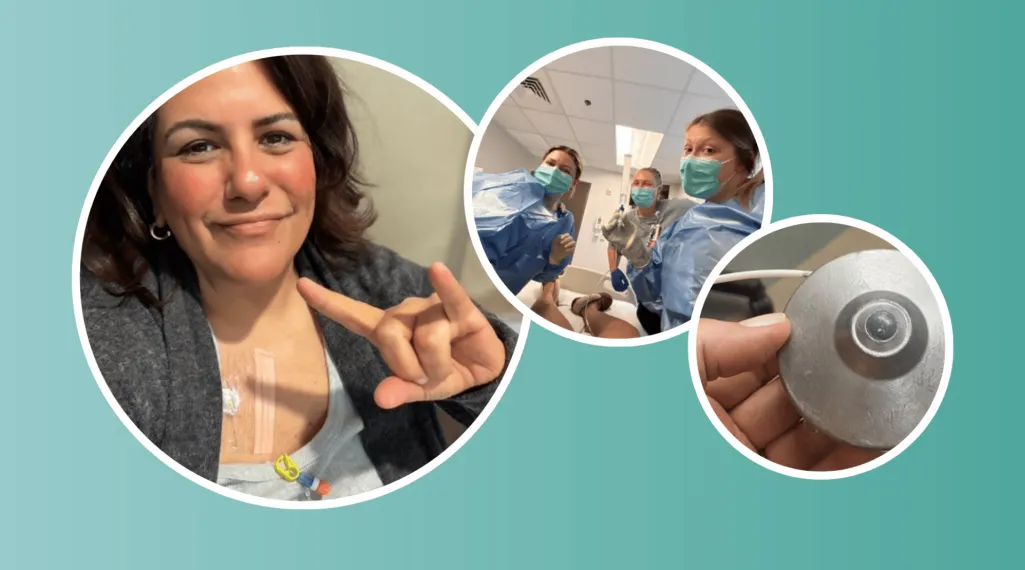
Several months into treatment, her oncologist raised an option known as Hepatic Artery Infusion (HAI) therapy. The treatment uses a small pump, surgically implanted in the abdomen, to deliver chemotherapy directly to the liver.
By focusing on the liver specifically, the pump allows for higher concentrations of medicine to reach the liver, while largely sparing the rest of the body from side effects.
Her oncologist considered Helen a strong candidate for the approach.
Helen was not so sure.
HAI therapy hadn’t been done at her hospital previously, so there weren't other patients there who could share their experiences.
"In an infusion room full of people on chemo, you can talk to someone about chemo all day long," she said. "But there was no one I could talk to about this pump."
Getting Comfortable
The turning point came through social media. Helen came across an article on Today.com about a man named Thomas who had received the HAI pump after a colorectal cancer diagnosis similar to her own.
"I opened the story, and it was like reading my own journey," Helen said. "His diagnosis, his story, his quotes. I said, 'Me too, Thomas,' at every single point."
The article ended with photographs of Thomas on a beach, holding his girlfriend's hand, looking healthy and vibrant.
"It was exactly what I needed to see," Helen said.
She decided to pursue the pump.
The decision brought relief, briefly. After months of research and consultations, Helen was preparing to receive the pump through a clinical trial.
But then she learned she did not qualify.
"I'd finally gotten comfortable with the idea," she said. "And then it was gone."
Rather than abandoning the idea, she joined the effort to bring an HAI pump program to her own hospital. She attended meetings. She spoke about it with the media. She shared on her own social channels.
In the end, the hospital launched the program, and Helen was the first patient there to receive an HAI therapy pump — she was a pioneer.
"That was a little scary, but also very maverick," she said. "Someone had to be first, and with all the research and conversations I'd done, I felt I was the right person. I also felt I could help educate the patients who followed."
Recovery was harder than she had anticipated. Still, she has no regrets.
"I would do it 50 times over," she said.

The Results
All 14 of her liver lesions, areas of tissue where cancer had established itself, shrank or became necrotic, meaning the cancer cells died. She subsequently underwent a liver resection to remove what remained.
Helen describes her experience as someone fully engaged in her own care. She was drawn to the science. She asked questions. Over time, she came to think of herself as the "CEO" of her health, responsible for understanding her options, advocating for herself, and helping drive decisions alongside her medical team.
"When you remind yourself of what you're doing it for, you'll do whatever it takes," she said. "It could be a pump. It could be a carburetor going in my body. I don't care. Whatever we have to do, we're going to do it."
Her scans now show no evidence of disease, a phrase she holds carefully. Her medical team has not yet said the exact words, and she is not inclined to press her luck.
"The pump changed the trajectory," she said.
Coming Full Circle
Helen herself was recently featured in Today.com, the same publication whose article about Thomas had shaped her decision to pursue the pump.
"That Thomas story on Today changed everything for me," she said. "And then I became the patient in a Today story. I cried."
Helen had spent 25 years as a cancer advocate with nonprofits, counseling patients through some of the hardest moments of their lives. After her own treatment and her public push to bring HAI therapy to her hospital, some of those same patients came back to thank her.
"I just want people to know that there is hope," she said. "It is constant. I don't say 'stay positive' because that's hard on some days. But stay hopeful. Stay the course. Do your research. Be the CEO of your diagnosis."
This article supported by

Top resources
Jenny Trefzger: "My missed expiration date"
Jenny Trefzger was 23 when gender-affirming care found her colon cancer. Nine years later, she wants readers to know that you don't have to be extraordinary to beat cancer.

FDA approves Tecentriq for some people with stage III colon cancer
The FDA has approved Tecentriq (atezolizumab), given with chemotherapy after surgery, for people with stage III colon cancer whose tumors are mismatch repair deficient (dMMR). It’s the first immunotherapy approved for this use.
Why I answer the phone: A cancer care navigator's view
Meet Paige Edmonds, a social worker behind the Alliance's helpline — and the personal loss that led her there.